
.webp)
Budget 2025: What is Carneynomics?
December 4, 2025
By Laurent Carbonneau
CCI Director of Policy and Research
If you actually think back to where Canada was a year ago, it’s almost enough to make your head hurt.
At the beginning of December 2024, Justin Trudeau was the Prime Minister, Chrystia Freeland was his loyal deputy, and all of the polling said that the Conservative Party was about to sweep into power.
But substantively, what’s changed in the last year? Well, with a new Prime Minister who’s a world-renowned economist, we’re really starting to get a clear picture of what Carneynomics looks like in action.
Succinctly, the core of Carney’s economic strategy is: Do more of what we already do. We’re going to sell more stuff to more places, and this will solve Canada’s perennial problems, like low productivity, capital formation and investment.
The centrepiece of the Prime Minister’s first months in office focused on the fight against internal trade barriers, and setting up the legal framework and administrative infrastructure for designated major national projects (which so far have been mostly mines and energy infrastructure and projects). The government also announced in October that it was beginning a new approach to capital budgeting (to the government’s great credit, this framework does recognize the importance of intangible assets).
The budget builds on these steps. A helpful info box about the government’s industrial strategy declares that they are focusing on four baskets of “high-impact actions for lasting growth”: infrastructure projects, R&D, regulatory reforms to address investment and trade malaise, and a new productivity “super deduction” for capital investments. Through a range of tax breaks, transfers, and direct commitments, the government is substantially increasing - doubling, really - the pace of capital investments it is making and incentivizing.
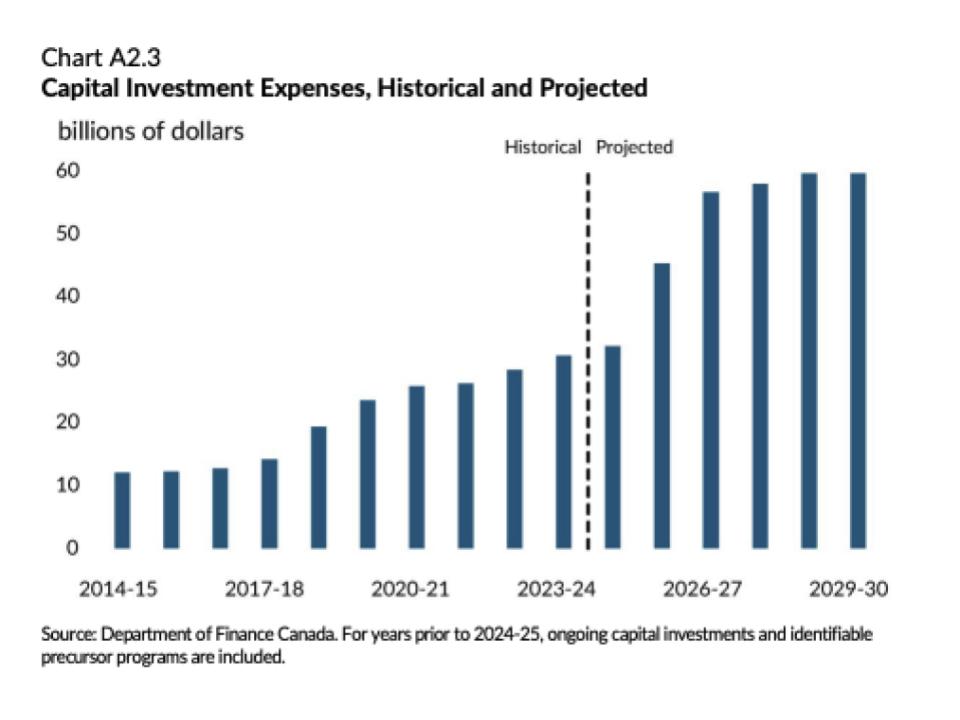
It should be said off the hop that there is a pretty clear logic to this, and I am broadly positive about the direction of travel. But it’s worth asking if that is enough.
Focusing on our primary export sectors is not a mistake — comparative advantage is an extremely powerful force, and there is considerable scope for adding value in our cornerstone industries that we are not using. At CCI we’ve previously written here about our opportunities in mining and forestry, and hosted a fascinating in-person conversation on innovation in agriculture and food.
But even in our cornerstone sectors, we’ve fallen behind.
In mining, we’ve been the #4 country for patent activity over the last decade — behind China, the United States and Australia — despite having the most domestically-headquartered mining companies. China alone accounts for 70% of mining patents filed from 2013-2023.
In agriculture, we’ve become much less research-intensive. At peak, back in the 1990s the Canadian agriculture industry was spending 2.5% of revenue on R&D, but the rate has declined to 0.5% since then.
And this is potentially the fatal flaw of the Carneynomics plan to boost the rate of production in mining, farming, forestry and other traditional industries.
The driving force behind innovation and scale is a solid foundation of freedom to operate created by owning key intellectual property and intangible assets. Our gap in scaling firms that can create and protect freedom to operate in the modern economy, in our view, is the biggest driver of underinvestment - it’s much harder to justify investing growth capital, spending on R&D, and investing in skilling up your workforce if you lack the assets you need to defend your ability to expand and grow.
In the 21st century it’s a lot more profitable to be John Deere providing the technology platform for farming, and it’s a lot less profitable to be the farmer. In every sector of the economy you either build the software and technology systems, or else you pay to licence somebody else’s technology, and they capture the greatest share of the economic value.
To be fair to Prime Minister Carney, it would be an over-simplification to act like doubling-down on traditional resource sectors is the only thing his budget is doing.
The government’s investments in things like defence industrial strategy, sovereign AI compute, quantum technology, and launching a new growth capital strategy, are all welcome signs in the right direction even if we’re waiting on critical details. The long-awaited changes to SR&ED reflect a lot of innovators’ priorities.
But owning what we invent and commercializing what we own has been the Canadian innovation ecosystem’s Achilles heel for half a century. And if we want to significantly change the trajectory we’re on, we need to do more.
On this front, there’s some reason for optimism. Budget 2025 included substantial spending for intellectual property programs.
The education and support programs Elevate IP and IP Assist have gotten new infusions of cash, and the Innovation Asset Collective has been refunded. This is good! The budget has also left open a door to do more on this front with a commitment to a review of federal IP policy.
In fact, the outlook for the federal government’s intellectual property strategy is interesting enough that it deserves its own blog post. Stay tuned for something on that front very soon.
--
Laurent Carbonneau is CCI's Director of Policy and Research. He can be reached at lcarbonneau@canadianinnovators.org. Mooseworks is the Council of Canadian Innovators' innovation policy newsletter. To get posts like this delivered to your inbox, sign up for CCI's newsletter here .
JOIN CCI'S NEWSLETTER