
.png)
CCI Field Notes: Waterloo Region
July 31, 2026
Hi CEOs, ride shotgun with me as we get off Highway 401 and take Highway 8 into Waterloo Region for this edition of Field Notes, CCI's special summer newsletter.
Driving northwest, we pass a bright orange Zehrs and drive under a highway sign that has always reminded me of the symbol for the Artist Formerly Known as Prince. It warns that the roads ahead will twist and turn into themselves as we head toward Kitchener, Guelph, Stratford and Waterloo.
The highway drops, sweeps and bends toward Kitchener. One curve hides the next. Lanes appear from odd angles. If you’ve never driven here before, you might wonder who designed the place.
Many of Waterloo’s roads trace pre-existing Indigenous footpaths and tracks that threaded through the central Grand River watershed. Early Mennonite settlers established homesteads along these routes and their horse drawn Contestoga wagons further defined these connections between farms, mills and villages. As travel increased, the paths were widened and gradually became roads
Locals understand the resulting street map—or at least know not to fight it. They also know that Weber Street is pronounced with a long “e”: Weeber. That is the second most interesting thing about Weber. The first is that it crosses King Street three times as the two roads weave through the region.
We pass the University of Waterloo, a big Brutalist campus that turns 70 next July. Local folklore says that when the campus was built, the university left some lawns without sidewalks. Then it waited. Students wore their preferred routes into the grass, and the university paved the paths that emerged. Today, those paths carry some of the world’s most sought-after engineers, architects and urban planners.
I point this out on our summer drive because the way we arrive in Waterloo Region tells us something about why we’re here. This is a community shaped by people who have always read the landscape, followed what worked and carved their own paths when necessary. This may help explain how this agricultural corner of southwestern Ontario became the entrepreneurial hub it is today.
Once we’re parked, don’t worry too much about which way is Uptown Waterloo, Downtown Kitchener, north or south. Just find your way to one of the places in our regional directory below.
First, let's check in with our Ontario Director, Hina Ahmed, then meet some local innovators and a few important companies we think you should know about.
And if you find yourself in the region on a Tuesday or Thursday this summer, make sure you add a detour to the St. Jacob's Farmers Market for an order of apple fritters. Your team will thank you.
Happy reading,
Patrick
Patrick Searle is the Chief Executive Officer of the Council of Canadian Innovators, a national member-based organization reshaping how governments across Canada think about innovation policy, and supporting homegrown scale-ups to drive prosperity. If you are interested in learning more about the Council or joining our cause, get in touch.
ON THE GROUND

Waterloo’s strength in research is well established. Last month, five faculty members from the University of Waterloo’s Institute for Quantum Computing received federal funding, adding to the region’s work in artificial intelligence, cybersecurity, transportation and advanced manufacturing.
The harder question is how more of that research becomes Canadian companies, intellectual property and economic value.
Miovision offers a useful example. The Kitchener-based company uses artificial intelligence to help cities manage traffic, producing the kind of Canadian-built, exportable technology that can improve public infrastructure. Yet companies like Miovision often find it easier to secure major customers abroad than at home.
As Miovision Chief Revenue Officer Lyne Jacques said at CCI’s Capital & Growth Summit this spring, “If Canada wants long-term competitiveness, it needs to back companies that can scale here and serve global markets from a Canadian home base.”
Governments and large Canadian organizations can help close that gap by becoming early customers. A domestic contract gives a growing company revenue, a commercial track record and a reference it can take into global markets. It also allows public institutions to solve real problems with technology developed here.
Procurement should therefore be treated as economic policy, not simply an administrative process. Ontario can create opportunities for Canadian firms in areas where the province already has an advantage, including transportation, healthcare, advanced manufacturing and financial services, while making trusted Canadian AI and cybersecurity products easier to buy.
Waterloo has shown that Canada can produce exceptional researchers, founders and technologies. The next challenge is ensuring that we do not become the world’s research lab while other countries capture the jobs, ownership and wealth.
Hina Ahmed is the Director of Ontario Affairs at the Council of Canadian Innovators. She can be reached at hahmed@canadianinnovators.org and on LinkedIn. Look for her at Waterloo Tech Week this September.
BUILT HERE
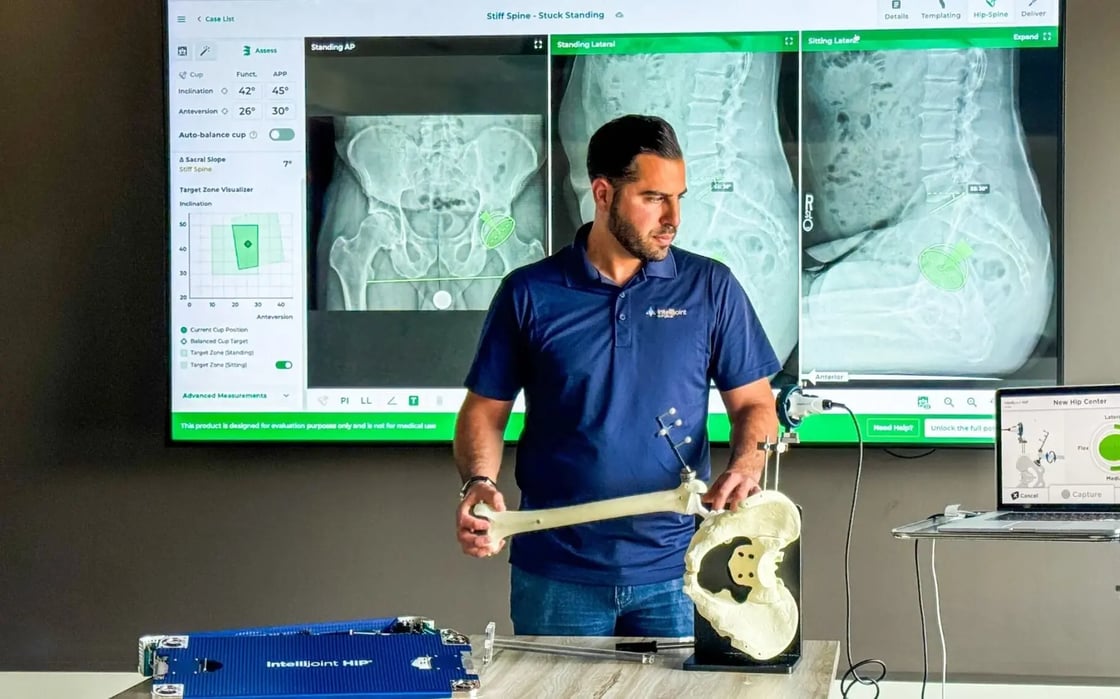
Intellijoint Surgical
Kitchener-based Intellijoint Surgical develops surgical navigation technology for total joint replacements. Its tools are designed to give orthopaedic surgeons accurate information during hip and knee procedures through technology that is compact and easy to use.
Led by co-founder and Chief Executive Officer Armen Bakirtzian, Intellijoint has taken technology developed in Waterloo into operating rooms in Canada and international markets. Its growth shows what can happen when local research, medical expertise and entrepreneurship come together around a clear commercial need.
The company has also helped strengthen the wider Canadian medical technology sector. Bakirtzian co-founded the Medical Innovation Xchange, known as MIX, an industry-led hub that helps medical technology companies access specialized expertise and scale from Canada.
Intellijoint represents an important part of Waterloo’s innovation story. The region’s impact is measured not only by the ideas developed there, but by the companies capable of turning those ideas into products that improve outcomes and compete globally.
Explore more Kitchener-Waterloo based companies in the CCI Directory.
ONE TO WATCH

Jason Cassidy, Chief Executive Officer of Shinydocs
Jason Cassidy has spent more than two decades helping organizations solve complex digital information challenges.
As founder and Chief Executive Officer of Kitchener-based Shinydocs, Cassidy leads a company that helps organizations understand and manage the large volumes of information stored across their systems. Its software inventories content so customers can find information, govern files, complete migrations and make better use of their data.
That work has become more important as organizations adopt artificial intelligence. Useful and reliable artificial intelligence systems depend on information that is organized, accessible and properly governed. Shinydocs is helping organizations build that foundation while managing security and compliance requirements.
Cassidy is also an active voice in Waterloo’s technology community and in discussions about Canadian procurement. His work reflects a wider strength of the region: leaders who are building companies while contributing to the conditions that allow other Canadian innovators to grow.
Learn more about Jason and other Kitchener-Waterloo based innovators on CCI's CEO Directory.
SEEN & HEARD

On June 9, we hosted an Innovator Exchange in Kitchener-Waterloo focused on the findings of CCI's Buying What We Build report and the role Canadian businesses can play in strengthening a domestic enterprise stack. The discussion brought together founders, innovators, and ecosystem leaders at the offices of Gowling WLG to explore how Canadian organizations can create more opportunities for homegrown companies while remaining competitive, open, and innovation focused.
Read the full event recap here.
THE CCI DIRECTORY

Keep these places in mind the next time business brings you to Waterloo Region, from the first coffee of the day to dinner after the final meeting.
Where to Take an Investor Coffee
Beside the Kitchener GO and VIA Rail station, Smile Tiger Coffee Roasters is a convenient place to meet anyone arriving from Toronto. For something sweeter, Lucero Canteen pairs good espresso with an impressive selection of doughnuts and baked goods. In Cambridge, Terroir Artisan Bakery serves sourdough bread and pastries from a small space inside a century-old factory in Hespeler Village.
Where to Host a Board Dinner
For more than dinner, Langdon Hall offers private meeting rooms and accommodations on 75 acres outside Cambridge. Its Michelin-recommended restaurant makes it a natural choice for a board retreat, while the grounds provide enough room for a useful walk when everyone has spent too long around the table.
Where to Work Between Meetings
Catalyst Commons, located inside Catalyst137, offers meeting rooms and flexible workspace in the heart of Kitchener’s hardware and advanced manufacturing community. The former tire factory is already home to some of the region’s fastest-growing companies, along with a café, restaurant, microbrewery, gym, and the official HQ for Intellectual Property Ontario (IPON). Den 1880 and the Builders Club are two other co-working options to look into as you plan your time in the region.
Where to Gather After the Event
Boathouse DTK sits beside the lake in downtown Kitchener’s Victoria Park. The longtime restaurant and live music venue recently reopened with the backing of a group of local entrepreneurs and community leaders, including people behind Miovision, Catalyst Commons, Turnstone, Strata Research, Waterloo Brewing and Digital Sabbath. That community effort is part of what makes the Boathouse worth visiting. It offers food, craft drinks and a waterfront patio, with a calendar of live performances, open-mic nights and other events, so check what is on before you go. For a quieter pint, Arabella Park Beer Bar has 18 rotating taps, a changing food menu and a bottle shop in Belmont Village.
Where to Stay
Built in 1893, The Walper Hotel has been part of downtown Kitchener for more than a century. Its central location puts you within walking distance of restaurants, cafés and many of the region’s technology offices.
Next week, we head west to Vancouver, site of the 2026 edition of Canada's CEO Summit this fall! Have a great weekend!
About the Council of Canadian Innovators (CCI)
The Council of Canadian Innovators (CCI) is Canada’s business council for the 21st century economy. We are a collective of over 175 of Canada’s fastest-growing and most ambitious companies, and the founders, CEOs, and executives behind them, working together to improve the business conditions that help more homegrown companies scale, compete globally, and drive long-term prosperity.
JOIN CCI'S NEWSLETTER